




The U.S. Consumer Product Safety Commission has received a comprehensive study prepared for CPSC by the National Academy of Sciences recommending that consumer exposure to formaldehyde be reduced to the lowest practical level.
After extensive analysis of existing formaldehyde research in the international health community., the National Academy's Committee on Toxicology concluded that on the basis of available data "there is no population threshold for the irritant effects of formaldehyde in humans. Information from controlled human studies and complaint-related investigations suggests that, even at extremely low airborne concentrations, a proportion of the population will respond with some irritation."
After examining various tests of animal and human exposure to formaldehyde, and especially in view of increasing concern over the long-term or "chronic effects of exposure to the chemical (including its potential carcinogenicity), the National Academy study offered the recommendation that "formaldehyde be kept at the lowest practical concentration in indoor residential air."
The National Academy's study, which was commissioned by CPSC in May, 1979, provides additional evidence for the agency to consider as it develops regulatory alternatives for consumer products containing formaldehyde, which include a popular form of home insulation called urea formaldehyde foam insulation (UF foam), plywood and particle board, various textiles and carpeting, and some plastics.
Research compiled by the National Academy included two European studies reporting responses from humans exposed to doses of formaldehyde gas ranging from .03 parts per million (ppm) to 4.0 ppm for periods of time ranging from 90 seconds to five hours per day for four days. (The two studies, involving about 100 healthy men and women, were conducted several years ago in Denmark and West Germany independently from U.S. scientists and health experts.)
CPSC already has received more than 600 complaints from consumers living in homes insulated with UF foam, with reported symptoms ranging from eye and skin irritation to breathing difficulties, persistent nosebleeds and nausea. Independent air samplings conducted predominantly by state and local authorities reported formaldehyde gas levels ranging from less than .l ppm up to 10 ppm and higher.
CPSC staff currently is working to prepare language for a warning label on UF foam installation contracts. The warning would alert homeowners to the potential problems which may arise from the installation of UF foam and exposure to formaldehyde gas.
Formaldehyde is not only a basic chemical building-block for products manufactured by a substantial number of U.S. industries, but also is a common gaseous by product of combustion. (CH2O) and, accordingly, is a common ingredient in urban air pollution.
Beginning this summer with UF foam insulation, the Commission will consider several approaches toward the regulation of formaldehyde gas, including the possibility of different limits for individual products, depending on such factors as the level of formaldehyde gas emitted from the product and the availability and cost of a substitute chemical in the product.
This summer CPSC staff and other federal experts expect to analyze the final results of a two-year cancer study of laboratory rats and mice exposed to varying doses of formaldehyde gas by inhalation being conducted by the Chemical Industry Institute of Toxicology. Preliminary results at the 18-month stage of the study showed that a high proportion of the laboratory rats (20 per cent) had developed a singular form of nasal cancer.
Alert Sheet From the U.S. Consumer Product Safety Commission
Urea Formaldehyde (Uf) Foam Insulation
The CPSC has received numerous consumer complaints about adverse safety and health effects that may be related to the release of formaldehyde gas from urea formaldehyde (UF) foam insulation. The insulation is also known as urea-based foam insulation, or simply foamed-in-place insulation.
Inhalation of the formaldehyde gas has been linked to a variety of symptoms such as:
-- Eye, nose, and throat irritation and other upper respiratory tract problems
-- Lower respiratory tract problems such as coughing, asthma, shortness of breath
-- Nausea and vomiting, and other gastrointestinal distress
-- Skin rashes
-- Nose bleeds
-- Headaches and dizziness
Formaldehyde is also a strong sensitize, which means that the sensitized individual may experience increasingly severe reactions to very low concentrations of formaldehyde. These reactions may take the form of asthma or skin rashes.
UF foam insulation is installed into existing wall cavities by drilling holes and pumping in the foam insulation through pressurized hoses, using specialized nozzles and pumping equipment. Some companies install the UE' foam insulation in attics, while others forbid this practice. The UF foam insulation can also be installed in new homes.
If you are considering this type insulation for your home, you should know that infants, the elderly, and those with allergies and respiratory problems may be particularly sensitive to formaldehyde gas. CPSC does not know at this time what percentage of the installations may result in adverse safety and health effects. When the problem does occur, it can be very difficult and expensive to remedy the situation. In some cases, interior walls have been removed, and the UF foam insulation taken out in an attempt to eliminate the formaldehyde gas problem. Generally this procedure is successful, but the Commission is aware of a few cases where formaldehyde gas emissions and health problems persisted after the UF foam insulation was removed. Some families have even vacated their homes when the problem persisted. Other remedies which industry representatives claim will help the situation are:
-- Ventilation - by opening windows and doors, and turning on air conditioners
-- Use of ammonia or other chemicals to neutralize the formaldehyde gas
-- Painting interior walls with oil-base paint
-- Use of chemically-treated air filters
The Commission has no information showing that these remedies are effective in most cases.
If you have decided to purchase UF foam insulation, you should do the following to minimize the possibility of adverse safety and health effects:
-- Select a reliable and experienced contractor.
-- Make sure the installer has been factory trained. Ask to see written verification of this training.
-- Obtain a written statement of specific corrective action the contractor will take if problems arise, including who will be responsible for removal of UF foam insulation, should that become necessary.
If UF foam insulation has been installed in your home, and you have experienced health or safety problems, or know of someone else who has had such problems, please call the toll-free hotline at (800) 638-2772 and report the incident to CPSC.
Formaldehyde In Consumer Products
Formaldehyde is a chemical used in many consumer products. ranging from construction materials and thermal home insulation to fabric finishes and paper bags. Formaldehyde may cause health problems when inhaled as a gas or when it comes in contact with skin.
The Hazards of Formaldehyde
Consumers have complained to the U.S. Consumer Product Safety Commission (CPSC) about a wide variety of reactions claimed to be caused by breathing the formaldehyde gas released from urea formaldehyde (UF) foam insulation. Persons with allergies or a history of respiratory ailments may be particularly sensitive to formaldehyde exposure.
The reactions reported by consumers include:
-- upper respiratory problems in the nose. sinus, and throat
-- eye irritation
-- lower respiratory problems such as coughing, asthma, shortness of breath
-- skin rashes
-- headaches, dizziness
-- nausea and vomiting, and other gastrointestinal distress
-- nose bleeds
After being installed, UF foam insulation may release formaldehyde gas into the home for a few days or. in some cases, for weeks or months. Some persons have been advised by physicians or decided on their own to move out of their homes during this period because of severe reactions to the formaldehyde gas.
Formaldehyde is also a strong sensitize. which means that the sensitized individual may experience increasingly severe reactions to very low concentrations of formaldehyde. These reactions may take the form of asthma-like symptoms or skin rashes. Sensitization presents serious problems since formaldehyde is used in the manufacture of many common consumer products.
Products in Which Formaldehyde is Used
In the home. some consumer products that include formaldehyde are:
-- urea formaldehyde foam insulation
-- plywood, particle board. and chip board
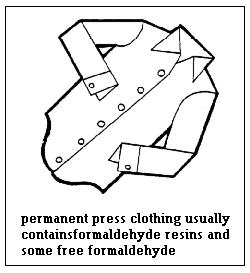
-- cotton clothing and fabrics. Including permanent press clothing, carpeting
-- paper products. such as grocery bags. wax paper, facial tissue
-- plastic parts in some appliances
-- mildew prevention chemicals
Consumers are most likely to be exposed to formaldehyde vapors from products such as urea formaldehyde foam insulation. plywood. particle board and chip-board. although CPSC has also received complaints about carpets. drapes, clothing and newsprint. Some of these may release formaldehyde gas. especially when the product is exposed to heat and humidity. The vapors that may be released from such products result from the free, formaldehyde present or from the breakdown of formaldehyde-containing resins.
CPSC is working with other government agencies, including the Occupational Safety and Health Administration, the Food and Drug Administration, the Environmental Projection Agency, the Department of housing and Urban Development and the Department of Energy, to research the effects of formaldehyde and to coordinate any regulatory action that might be undertaken.
|

CPSC is working with other government agencies, including the Occupational Safety and Health Administration. the Food and Drug Administration, the Environmental Protection Agency. the Department of Housing and Urban Development and the Department of Energy, to research the effects of formaldehyde and to coordinate any regulatory action that might be undertaken.
Regulatory Work and Testing of Formaldehyde
CPSC requires. under the Federal Hazardous Substances Act. that products containing one percent or more formaldehyde be labeled to warn of allergic and other skin irritations. Tests are now being planned or conducted by government. industry. and others to determine the chronic effects of formaldehyde. Based on preliminary test results. the Chemical Industry Institute of Toxicology has announced. in an on-going study. that breathing formaldehyde vapors at 15 parts per million in the air causes nasal cancer in rats. Generally, formaldehyde gas is found at lower levels in the home. CPSC. working with the National Toxicology Program. is forming a Federal panel of science and health experts to study the human health implications of these tests.
CPSC has initiated a contract with the National Academy of Sciences seeking to determine whether there is a safe level of formaldehyde gas in the home. CPSC has strongly urged that formaldehyde be tested intensively by the National Toxicology Program in 1980 for its carcinogenic effects, as well as for possible birth defects and genetic mutations. CPSC also heads a Federal work group to coordinate regulatory and research efforts by CPSC, the Occupational Safety and Health Administration, the Environmental Protection Agency, the Food and Drug Administration. the Department of Energy, and the Department of Housing and Urban Development.
In addition to CPSC. other Federal agencies have regulated various aspects of formaldehyde exposure. The Occupational Safety and Health Administration has set maximum worker exposure to formaldehyde at three parts per million in the air over 8 hours. The Food and Drug Administration (FDA) requires that formaldehyde contained in cosmetics--including some shampoos. mascara. nail hardeners--be listed on the ingredients label. FDA guidelines limit the amount of free formaldehyde in nail hardeners. The Department of Energy has pro- posed material and installation standards for urea formaldehyde foam insulation.
The Department of Housing and Urban Development (HUD) is actively studying the release of formaldehyde gas in mobile homes where large amounts of plywood and particle board are used. HUD has not approved the use of UF foam insulation in new mobile homes. and in new HUD-financed single-family dwellings, the agency specifies requirements for UF foam insulation.
What the Consumer Can Do
If you have urea formaldehyde foam insulation or plywood. particle board, or chip board in your home. and you are suffering any of the health symptoms listed previously. you may want to have your home tested for formaldehyde in the air. Some local. county, and state health departments can measure the amount of formaldehyde in the air. If this service is not available in your locale, certain private laboratories will measure formaldehyde levels, for a fee.
You can also ventilate your home by opening windows and doors and turning on air conditioners for several days to try to reduce the odor problem.
Persons with allergies or a history of respiratory ailments. or with infants in the family, should consider these hazards before installing urea formaldehyde foam insulation In the home. The State of Connecticut. in fact, has an agreement with some UF foam Insulation firms that they will warn potential buyers of the Possible hazards of the product. In November, 1979. the State of Massachusetts banned the sale of urea formaldehyde foam insulation.
It is very difficult and expensive to remove UF foam insulation from the walls once it has been installed: in some cases the interior walls must be removed in order to take out the insulation. To reduce the chances of release of potentially hazardous formaldehyde gas from UF foam insulation, consumers should take the following steps before hiring a professional installer of foam insulation:
-- Select a reliable and experienced contractor.
-- Make sure the installer has been factory trained. Ask to see written verification of this training.
-- Obtain a written statement of specific corrective action the contractor will take if problems arise. including who will be responsible for removal of the insulation, should that become necessary.
-- Make sure that the foam is tested for performance by having the contractor foam several samples to make sure that it will set up and that it is of the proper density.
Home buyers with allergies or known sensitivity to formaldehyde should ask their builder what insulation is being used. and consider changing from urea formaldehyde foam insulation to another type before buying the home.
CPSC is particularly interested in being notified about any health or safety problems arising from formaldehyde, especially where formaldehyde in the air has been measured. Either write to the U.S. Consumer Product Safety Commission. Washington. D.C. 20207. Or call the toll- free hotline. 800-638-2772.
About the U.S. CPSC
The U.S. Consumer Product Safety Commission (CPSC) is charged with protecting the public from unreasonable risk of injury associated with the use of thousands of types of consumer products. Deaths, injuries, and property damage from consumer product-related incidents cost the nation more than $1 trillion annually. Since the CPSC was established more than 50 years ago, it has worked to ensure the safety of consumer products, which has contributed to a decline in injuries associated with these products.
Federal law prohibits any person from selling products subject to a Commission ordered recall or a voluntary recall undertaken in consultation with the CPSC.
For lifesaving information:
- Visit CPSC.gov.
- Sign up to receive our email alerts.
- Follow us on Facebook, Instagram, X, BlueSky, Threads, LinkedIn and Truth Social.
- Report a dangerous product or a product-related injury on www.SaferProducts.gov.
- Call CPSC’s Hotline at 800-638-2772 (TTY 800-638-8270).
- Contact a media specialist.
Please use the below phone number for all media requests.
Phone: (301) 504-7908
Spanish: (301) 504-7800